
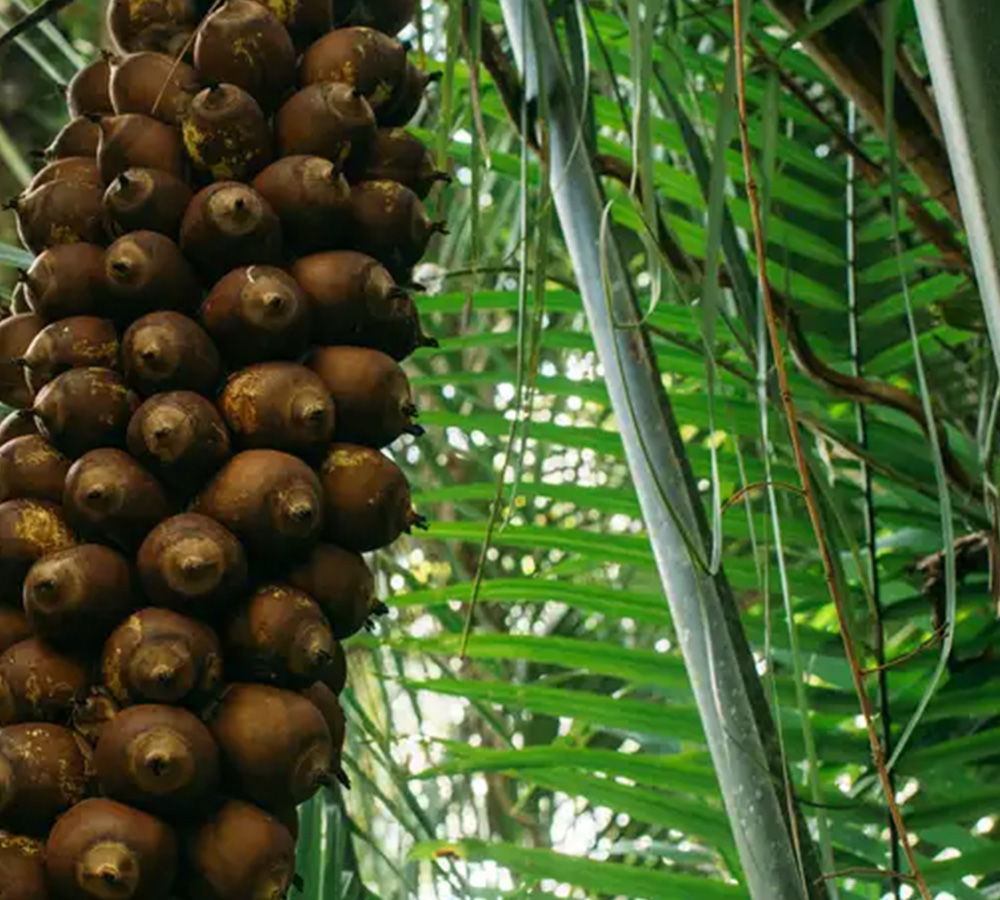

Discover babassu, the native Amazonian palm behind a fast-growing bioeconomy, and why the world is starting to pay attention.
Babassu (Attalea speciosa) is one of the most abundant native palms in Brazil, covering vast areas of the transition between the Amazon and the Cerrado. Its heartland is Maranhão, in the Legal Amazon, where millions of these palms grow across a region often called the “babassu zone.”
What makes babassu remarkable is not just its scale, but its completeness. A single fruit contains four distinct layers, each with its own industrial value: the fibrous outer shell (epicarp), a starch-rich layer (mesocarp), a hard woody layer (endocarp), and the oil-bearing kernels inside. For generations, communities have harvested the fruit and cracked it by hand to reach the kernels, the source of babassu oil.
Today, that traditional knowledge is meeting industrial technology. Instead of using only the kernel and discarding the rest, integrated processing makes it possible to turn every fraction of the fruit into a product, from cosmetics to clean energy. This is the shift that transforms babassu from a subsistence resource into the raw material of a modern bioeconomy.
At BIOASSU, that is exactly the mission: taking a native fruit that has sustained families for centuries and building around it an industry that reaches global markets, without cutting down a single palm.